

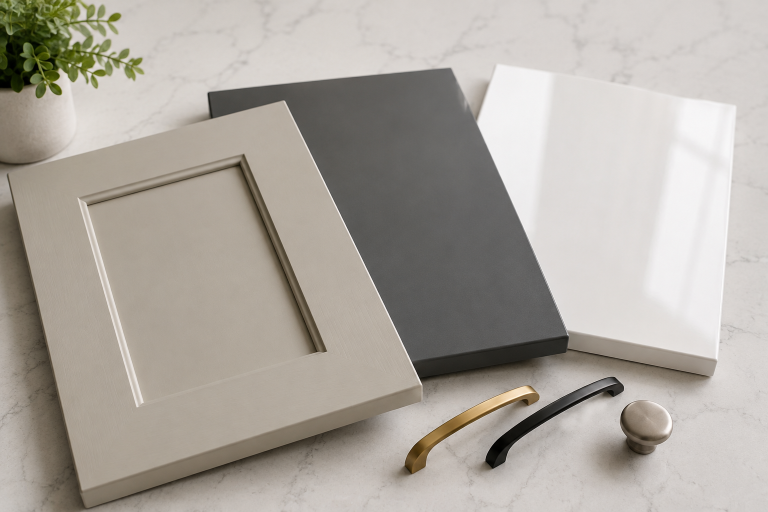
If your kitchen layout still works but the doors are looking tired, dated or damaged, you may not need to replace the whole kitchen.
Replacement kitchen doors can completely refresh and modernise the room while keeping the existing cabinet units in place. It is a practical way to transform the kitchen with less waste, less disruption and a faster turnaround than starting again.
But before choosing new doors, there are a few important things to think about, including size, style, finish, colour and how the doors will work with the rest of your kitchen.
Here is what you need to know.
What size are standard kitchen cupboard doors?
There is no single universal size for kitchen cupboard doors in the UK.
Many modern kitchens use common cabinet widths such as 300mm, 400mm, 450mm, 500mm and 600mm, with doors manufactured slightly smaller than the cabinet itself to allow the correct gaps between them. Retailers such as B&Q and Howdens offer doors across these common widths, but exact dimensions vary between manufacturers and ranges.
For example, Howdens lists many standard full-height base-unit doors at around 720mm high, available in widths including 300mm, 400mm, 450mm, 500mm and 600mm.
However, that does not mean you should assume your current doors are a standard size.
Older kitchens, discontinued ranges and kitchens from different manufacturers can all have slightly different kitchen cupboard door sizes.
You may also have:
- Tall larder doors.
- Wall-unit doors.
- Drawer fronts.
- Integrated appliance doors.
- Corner doors.
- Unusual or bespoke units.
That is why accurate measuring is so important.
Can you replace kitchen doors in any kitchen?
In many kitchens, yes, but the existing cabinet units need to be suitable.
Replacement kitchen doors are particularly effective when:
- The current layout works.
- The cabinet units are solid and secure.
- Hinges can be fitted correctly.
- The cupboards themselves are not swollen or badly damaged.
- You want to change the appearance rather than redesign the layout.
This means you can achieve a significant update without replacing everything.
Kitchen doors are one of the largest visible elements in the room, so changing them can dramatically alter the overall style while keeping the parts of the kitchen that are still perfectly functional. Howdens similarly describes replacement doors as a way to transform an existing layout without the need for a full renovation.
There will be occasions when a full replacement makes more sense, for example if the cabinet units are badly damaged or you want to completely change the layout.
A professional assessment should establish this before new doors are ordered.
What if my doors aren't a standard size?
This is where made-to-measure replacement kitchen doors can be particularly useful.
Rather than trying to make an existing kitchen fit around a limited selection of standard sizes, doors can be manufactured to suit the dimensions of the existing units.
This can be especially helpful for:
- Older kitchens.
- Discontinued kitchen ranges.
- Unusually sized cupboards.
- Bespoke layouts.
- Kitchens that have been altered over time.
Made-to-measure doors can help create a much more consistent, professionally finished result across the whole kitchen.
How do I measure for replacement kitchen doors?
Accurate measuring is essential.
Do not simply measure the cabinet opening and assume that is the required door size. Replacement doors usually need small clearance gaps between neighbouring doors and drawers.
If you are measuring existing doors, measure the door itself, rather than the cabinet behind it.
Measure the width
Measure from the left edge of the existing door to the right edge.
Measure the height
Measure from the top edge to the bottom edge.
Measure every door
Do not assume two doors that look the same are identical.
It is worth measuring every door and drawer front individually, particularly in an older kitchen. B&Q specifically advises measuring individual doors and checking hinge positions because dimensions can differ between brands and installations.
Check hinge positions
The location of the hinge holes matters just as much as the overall door dimensions.
Incorrect hinge positioning can result in doors that do not align properly with neighbouring cupboards.
For this reason, if you are investing in a full kitchen makeover, having the doors
professionally measured and fitted removes much of the risk.
What are the best replacement kitchen door styles?
There isn’t one style that is best for every kitchen.
The right choice depends on the look you want, the age and style of your home and how future-proof you want the kitchen to feel.
Shaker kitchen doors
Shaker doors have a simple framed design and remain one of the most timeless door styles.
They work particularly well in:
- Traditional homes.
- Contemporary country kitchens.
- Transitional kitchens.
- Kitchens where you want something modern but not overly trend-led.
Because the detailing is relatively simple, Shaker doors can change character depending on the colour and handles you choose.
A pale neutral Shaker door with brushed metal handles can feel contemporary, while deeper colours and brass hardware create a more traditional look.
Slab kitchen doors
Slab doors have a completely flat front with minimal detailing.
They are ideal for:
- Modern kitchens.
- Compact kitchens.
- Minimalist interiors.
- Homeowners looking for an easy-to-clean, low-maintenance finish.
Handleless and J-pull styles
Handleless-style doors create an even more streamlined appearance.
They work especially well in modern kitchens where clean lines are the priority. A J-pull design incorporates the grip into the door itself, reducing the need for separate handles.
The downside is that highly contemporary door styles can be more trend-led than a simple Shaker or slab design.
If longevity is important, consider how you are likely to feel about the style in five or ten years.
Matt vs gloss kitchen doors: which should you choose?
Both can work well. The difference is mainly in appearance, light reflection and maintenance.
Matt kitchen doors
Matt finishes absorb rather than strongly reflect light, creating a softer appearance.
Why choose matt?
- Contemporary, understated look.
- Works well with deeper colours.
- Often feels more premium and design-led.
- Generally shows reflections less than gloss.
- Works particularly well with shaker and slab doors.
Howdens describes matt as a muted, tactile finish that works across contemporary colour schemes. Matt is a particularly good choice if you want a kitchen that feels calm, timeless and modern.
Gloss kitchen doors
Gloss surfaces reflect more light around the room.
Why choose gloss?
- Bright, clean appearance.
- Reflects natural and artificial light.
- Can help a compact or darker kitchen feel lighter.
- Easy to wipe clean.
Howdens specifically notes that gloss doors can maximise natural light and help smaller kitchens feel roomier.
The trade-off is that fingerprints, smears and marks can be more visible on highly reflective finishes, particularly darker colours.
So, should you choose matt or gloss?
Choose matt if you prefer:
- Softer styling.
- A contemporary premium feel.
- Understated finishes.
- A timeless look.
Choose gloss if you want:
- Maximum light reflection.
- A brighter appearance.
- A sleek contemporary finish.
There is no universal winner in the matt vs gloss debate. The best choice depends on your kitchen, lighting and how much everyday cleaning you are comfortable with.
What colour kitchen doors should you choose?
Colour can completely change how the room feels.
Lighter colours such as warm white, ivory, stone and pale greige can help create a brighter, more open kitchen.
Deeper shades such as navy, forest green, charcoal and walnut tones can create a stronger statement and a more premium feel.
When choosing, consider the colours that are staying in the kitchen, including:
- Flooring.
- Worktops.
- Splashbacks.
- Wall colour.
- Appliances.
- Natural light.
The aim should be to create a coordinated scheme rather than choosing the door colour in isolation.
If you are replacing the worktops at the same time, choose the doors and worktops together. These are the two largest visual surfaces and will have the greatest influence on the finished look.
What should I consider when choosing replacement kitchen doors?
Before deciding, work through these seven questions.
1. Is the existing kitchen worth keeping?
If the units are solid and the layout works, replacing the doors can offer excellent value for money.
2. What style will suit the home long term?
Think beyond current trends.
Simple Shaker and slab designs are popular because they can be adapted through different colours, handles and worktops, making them more future-proof.
3. How durable does the finish need to be?
A busy family kitchen needs doors designed to handle frequent opening, cleaning and everyday knocks.
Look for a durable, high-quality finish rather than choosing purely on colour.
4. How much maintenance are you comfortable with?
Some finishes are more forgiving than others.
If low maintenance matters, consider how easily fingerprints, grease and marks will show before deciding between matt, gloss and textured finishes.
5. What handles will you use?
Handles can dramatically change the character of the same door.
For example:
- Shaker + cup handles = more traditional
- Shaker + slim brass bars = contemporary
- Slab + black handles = modern
- Slab + brushed nickel = understated
6. Are you changing anything else?
If you are also updating your worktops, splashback, sink or tap, choose all the finishes as part of one scheme.
This creates a professionally finished result rather than a collection of individual updates.
7. Is professional fitting worth it?
Replacement doors need to sit square, with consistent gaps and correctly aligned handles.
Small inaccuracies become surprisingly noticeable when several cupboard doors are next to each other.
A professionally fitted kitchen makeover provides a more reliable finish while also making the process more stress-free.
Standard vs made-to-measure replacement doors
Both have their place.
Standard doors can work well when your existing units match readily available dimensions.
Made-to-measure doors offer more flexibility, particularly when working with an existing kitchen from another manufacturer or an older range.
The important thing is not whether a door is labelled standard or bespoke. It is whether it fits the existing kitchen correctly and creates a consistent result.
Are replacement kitchen doors worth the investment?
For the right kitchen, they can offer excellent value for money.
Instead of removing perfectly usable cabinets, you keep the existing structure and invest in the parts you actually see.
That can mean:
- Less disruption.
- Faster installation.
- Less waste.
- Lower overall cost than a complete refit.
- A dramatically updated appearance.
- A durable, high-quality finish.
- The opportunity to change both colour and style.
It is also a more sustainable approach because it encourages homeowners to reuse instead of replace where the existing kitchen is still structurally sound.
Rather than ripping everything out, you are making a conscious upgrade to the parts that need changing.
A kitchen makeover can go beyond the doors
Replacement kitchen doors can make a dramatic difference on their own, but they can also form the basis of a more complete makeover.
At Kitchen Makeover Group, a transformation can include:
- Replacement cupboard doors and drawer fronts.
- Handles.
- Worktops and quartz overlays.
- Splashbacks and upstands.
- Sinks and taps.
- Cornice, pelmets and plinths.
By coordinating these elements, you can completely transform the appearance of an existing kitchen without replacing everything.
If the layout already works, this can be a practical, affordable and long-term alternative to a full kitchen refit.
Ready to update your kitchen doors?
Choosing replacement kitchen doors is about more than picking a colour you like.
Getting the dimensions, style, finish and fitting right will determine whether the finished kitchen looks like a simple update or a complete transformation.
At Kitchen Makeover Group, we help homeowners keep what works and replace what does not, creating a modern, durable kitchen with minimal disruption and a high-quality finish that is built to last.
Book a free, no-obligation consultation to explore replacement kitchen doors for your home.
FAQs
What are standard kitchen cupboard door sizes in the UK?
Common cabinet widths include 300mm, 400mm, 450mm, 500mm and 600mm, although exact door dimensions vary by manufacturer. Heights also vary depending on whether the door is for a base, wall, tall or appliance unit.
Can you replace kitchen doors without replacing the cupboards?
Yes, provided the existing cabinet units are structurally sound and suitable for reuse. This can transform the appearance of the kitchen with significantly less disruption than replacing everything.
Can you get made-to-measure replacement kitchen doors?
Yes. Made-to-measure doors are particularly useful for older kitchens, unusual cabinet dimensions or ranges that are no longer available.
What is the most timeless kitchen door style?
Shaker doors are one of the most versatile and timeless options because their simple framed design works in both traditional and contemporary kitchens. Simple slab doors are also a strong future-proof choice for modern interiors.
Are matt or gloss kitchen doors easier to maintain?
Both can be easy to clean, but gloss finishes tend to show fingerprints and streaks more readily because they reflect light. Matt finishes are often more forgiving visually, although this varies by product and colour.
How should replacement kitchen doors be measured?
Measure the existing door itself for width and height rather than assuming the cabinet opening is the required size. Every door and drawer front should be checked individually, along with hinge positions.
Do replacement kitchen doors add value?
A well-finished kitchen can improve the overall appeal of a home. Replacement doors can create a much fresher, more modern appearance without the investment required for a complete new kitchen, although any effect on property value will depend on the property and wider market.