

If you’re thinking about updating your kitchen, it’s easy to assume you need a full refit. For plenty of homes, you don’t.
A kitchen makeover focuses on the parts you see and use every day, while keeping the layout and existing units (carcasses) if they’re still solid. That usually means less disruption, a quicker turnaround, and a more controlled budget.
This guide explains what changes the cost, how long it typically takes, and what to expect.
First: what counts as a ‘kitchen makeover’?
- Replacement doors and drawer fronts
- Worktops (Including Quartz overlay)
- Handles
- Splashbacks
- Sinks and Taps
- Fitting customer supplied built-in appliances
Most customers choose a combination of the above, depending on what bothers them most about the current kitchen.
How much does a kitchen makeover cost in the UK?
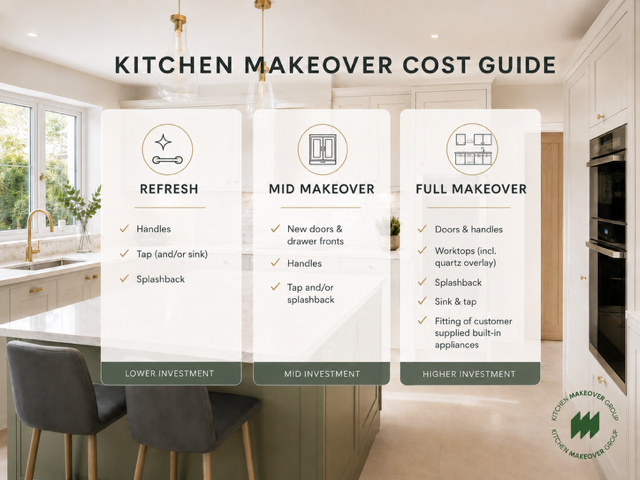
There isn’t one fixed price, because the cost depends on what you change and how big the kitchen is. The best way to think about it is in three simple levels.
1) A 'refresh' Makeover
Best for: kitchens that function well but look dated.
Usually includes:
- Handles
- Tap (sometimes sinks as well)
- Splashback refresh
Why it works: small changes that modernise fast.
2) A 'Mid' Makeover
Best for: the biggest visible upgrade without changing everything.
Usually includes:
- Doors and drawer fronts
- Handles
- Often a new tap and/or splashback
Why it works: doors are a huge part of what you see, so the room can feel brand new quickly.
3) A 'Full Makeover' (without refit)
Best for: kitchens where the layout works, but everything feels tired.
Usually includes:
- Doors & Handles
- Worktops (sometimes quartz overlay if suitable)
- Splashback
- Sink and Tap
- Fitting customer supplied built-in appliances, if you're updating them.
Why it works: you get that ‘new kitchen’ look and feel without ripping out your existing units.
What affects the price most?
If you want to understand where budgets go, these are the biggest drivers.
1) Number of doors and drawers
More doors and drawers means more material, more hardware, and more fitting time.
What can increase cost:
- Lots of drawers
- Tall units
- Corner solutions
2) Door style and finish
Some finishes and styles cost more than others.
In plain terms:
- A simple slab door is often more straightforward
- Shaker and more detailed profiles can cost more
- Premium finishes can cost more, but may be more forgiving day to day
3) Worktop choice
Worktops vary a lot by material and complexity.
Cost is affected by:
- Size (runs and depth)
- Cut-outs (sink, hob)
- Edge profile
- Joints and seams
- Whether quartz overlay is suitable (and what finishing details are needed)
4) Splashback size and type
A small splashback behind the hob is a different job from a full wall splashback.
5) Sink, tap and accessories
Taps vary hugely. The same goes for sinks, especially if you choose different sizes and materials.
6) Your current kitchen’s condition
The big money saver is keeping solid units and a workable layout. If the underlying units are damaged, uneven, or poorly fitted, that can limit options or require additional work.
How long does a kitchen makeover take?
The honest answer: it depends on what you’re doing, but it’s often much quicker than people expect.
Typical timelines
- Handles or tap only: can be quick once items are chosen and on site
- Doors and handles: often completed quickly once measured and made
- Worktops: fitting depends on the material and the size of the job
- Full makeover (doors + worktops + splashback + sink/tap): often completed over a short, planned window
If you’re doing multiple upgrades, the key is sequencing so you’re not without a working kitchen for longer than necessary.
What the process usually looks like (simple version)
Step 1: Measure and suitability check
This is where we confirm:
- Your units are solid and worth keeping
- What’s possible with your layout
- What worktop options suit the space (including whether quartz overlay is appropriate)
Step 2: Choices and final quote
Once you’ve chosen:
- Door style and colour
- Handle finish
- Worktop type
- Splashback style
- Sink and tap
…we can give a clear quote based on your exact kitchen.
Step 3: Install
We plan the order to minimise disruption. For example:
- Doors and handles can be fitted without making the kitchen ‘out of order’
- Worktops and sink changes are planned carefully, as they affect water and day-to-day use
- Splashback is typically fitted after worktops
Step 4: Built-in appliances (if you supply them)
If you’re updating built-in appliances you’ve already purchased, we can fit them as part of the makeover plan. We’ll confirm measurements and compatibility early so there are no surprises.
‘Will I be able to use my kitchen during the makeover?’
Most of the time, yes, in some form.
Realistically:
- You may have a short period where the sink or hob is unavailable if those are being changed.
- The goal is to plan those moments so they’re predictable and kept as short as possible.
A simple tip: if you’re changing worktops and sink, plan a ‘make do’ station (kettle, toaster, washing up bowl) for a day or two, just in case.
Kitchen makeover vs full refit: when is a refit actually the better choice?
A full refit may be the right option if:
- The layout doesn’t work for you at all
- Your units are damaged or unstable
- You want to move plumbing, electrics, or major appliances to new positions
- You want structural changes (walls removed, big reconfiguration)
A makeover is often ideal if:
- The layout works
- The units are sound
- You want a fresh look and feel without major building work
A good next step
If you’re considering a full refit, but your kitchen layout works, it’s worth checking whether a makeover could give you what you want for less disruption.
The quickest way to give us a call and we can chat about what you want to change.
Choose Kitchen Makeover Group. The smarter alternative to a new kitchen.